Urban base & form
The pagoda sits at an open downtown junction; the octagonal gilded body stands out between City Hall and the park, with gentle platforms letting visitors approach the base without harming the heritage.
Rating 4.4 · 6,618 Google reviews — source: Google Maps (accessed October 2026).
ဆူးလေဘုရား - ရန်ကုန်မြို့၏ အသည်းနှလုံး
A golden pagoda at the junction of Sule Pagoda Road and Maha Bandula Road in downtown Yangon, Myanmar. Believed founded during the lifetime of the Buddha over 2,000 years ago, it enshrines a hair relic of the Buddha. Its octagonal body is gilded and rises about 46 m. It is both Yangon's urban landmark and Buddhist center, and a rallying point for peaceful demonstrations, surrounded by Maha Bandula Park, Yangon City Hall, and the Independence Monument.
🔗 Hours & tickets per Yangon City / on-site info
'Sule' is named after the guardian spirit (Nat) of this place. Standing at the exact center of the city, the pagoda is like Yangon's beating heart — for over two millennia it has quietly gathered the city's noise and prayers.
— The origin of Sule Pagoda
Golden Hour Calculator · Light Tool
Based on today's sunset, we recommend arriving about 60 minutes earlier to catch the softest diffuse city light and the blue hour on the gilded spire — ideal for photographing Sule Pagoda and the surrounding colonial buildings.
Sule Pagoda sits in a busy downtown intersection surrounded by high-rises and traffic; light is warmest at dawn and dusk. On weekends or clear days, allow extra time to avoid crowds.
🌇 Sunset tip: Sule Pagoda stands at an open downtown junction, a convenient spot to watch the city sunset. The first warm light on the gilded spire and Maha Bandula Park at dusk is the golden window for photography; Yangon is hot year-round, so bring water and sun protection.
Light quality updates with the sun
Arrive by
16:41
Blue hour
17:41–18:11
A few numbers to read this golden pagoda at the heart of Yangon at a glance.
46 m
Main stupa height ($\approx 151$ ft)
Octagonal
Body structure ($Octagonal$)
Gold leaf
Surface material
Pagoda / Pagoda
Urban faith center
Sule Pagoda is Yangon's downtown Buddhist landmark. Its octagonal body runs from base to spire, crowned by a gilded finial — a place for locals to pray and visitors to pilgrimage.
Relic / Relic
Hair relic of the Buddha
The pagoda is said to enshrine a hair relic of the Buddha, sharing the same origin as Yangon's other great shrine, Shwedagon Pagoda — a key node of Burmese Buddhist faith.
History / History
Over 2,000 years
Believed founded during the Buddha's lifetime, over two millennia old; in modern times it became a rallying point for the 1988 and 2007 peaceful demonstrations, carrying the city's collective memory.
Coordinates / Coords
about 16.78°N, 96.17°E
WGS84: 16.7833, 96.1667. Plus Code: Q5F5+WG Yangon. Address: Sule Pagoda Road × Maha Bandula Road, Yangon 11141, Myanmar.
Admission / Admission
Foreign ticket
Local devotees enter free; foreign visitors buy a ticket at the entrance (a few USD), subject to on-site notice.
Hours / Hours
04:00–23:00
Open from early morning to night; dawn and dusk are coolest and best for photos and quiet reflection.
Plan Around the Weather
Yangon is a tropical monsoon city: a clear morning can turn into an afternoon downpour. Check the outlook before you set out, then decide whether to walk or take a taxi.
No weather risk warnings right now
Right now at the pagoda
28°C
Mainly clear
33° / 26°
Updated 22:17 · Yangon local time
Feels like
34°C
Humidity
92%
Wind
9 km/h · gusts 17 km/h
Rain chance
69%
UV index
8
Sunset
17:41
What to wear
How to plan your visit
What to bring
Today
33° 26°
☔ 69%
DrizzleTue
33° 25°
☔ 45%
ThunderstormWed
33° 25°
☔ 69%
DrizzleThu
32° 25°
☔ 53%
ShowersFri
32° 25°
☔ 46%
DrizzleSat
32° 25°
☔ 77%
DrizzleSun
32° 25°
☔ 76%
Drizzle🧭 About this site's environment
This is an urban cultural heritage site in the downtown grid, not a coastal or mountain destination, so sea and mountain hazards do not apply. What actually matters here is heat, humidity, rain and wind on an open-air stone platform with no roof.
The shrine stands on an open platform without a roof, so weather is the main variable of any visit: rain makes the stone slippery, and midday sun makes it uncomfortably hot underfoot. The seasonal strategy below explains how each period changes the experience.
Sule Pagoda (ဆူးလေစေတီတော်) stands at the junction of Sule Pagoda Road and Maha Bandula Road in downtown Yangon, Myanmar — a golden pagoda at the heart of the city. Believed founded during the Buddha's lifetime over 2,000 years ago, it enshrines a hair relic of the Buddha. Its octagonal body is gilded and rises about 46 m. Maintained by monks, it has long been a city center where devotees pray, travelers pilgrimage, and citizens gather — one of Yangon's city cards of 'city, history, and faith'.
Sule Pagoda stands at the junction of Sule Pagoda Road and Maha Bandula Road in downtown Yangon — a golden pagoda believed founded during the Buddha's lifetime. Enshrining a hair relic of the Buddha, its octagonal body is gilded and rises about 46 m. Maintained by monks, it is a center where citizens pray, travelers pilgrimage, and the city gathers — one of Yangon's city cards of 'city, history, and faith'.
Visitor Guide & Location
Welcome to Sule Pagoda, widely recognized as the central Sule Pagoda landmark. Located in the heart of Yangon, Yangon Region, Myanmar (Burma), this destination serves as a primary hub for travelers visiting the region. Sule Pagoda (ဆူးလေစေတီတော်) enshrines a hair relic of the Buddha, and its octagonal gilded body rises about 46 m at the junction of Sule Pagoda Road and Maha Bandula Road.
Sule Pagoda is located in Yangon, Yangon Region, Myanmar (Burma), at the junction of Sule Pagoda Road and Maha Bandula Road, Yangon 11141 (Plus Code Q5F5+WG). Coordinates: 16.7833, 96.1667. It is a short walk from Yangon Central Railway Station and the surrounding downtown blocks, or about 30–45 minutes by taxi / Grab from Yangon International Airport (RGN).
Where it sits
Map & Directions
Q5F5+WG Yangon, Myanmar (Burma) · 16.7833, 96.1667 · ☎ +951371561
When visiting Sule Pagoda, visitors can easily explore surrounding historical landmarks and points of interest, including Maha Bandula Park and Yangon City Hall.
Sule Pagoda is believed to have been founded during the lifetime of the Buddha, more than 2,000 years ago, and enshrines a hair relic of the Buddha. Named after the guardian spirit Sularata (Sule Nat), it was chosen in the 1850s by engineer Alexander Fraser as the geometric centre of Yangon's colonial grid plan. In modern times it became a rallying point for the 1988 and 2007 peaceful demonstrations, and it remains a living centre of Buddhist faith in downtown Yangon.
Putting the founding legend, the octagonal structure, the hair-relic faith, and modern urban movements on one timeline is how you truly understand why this pagoda is more than 'a pretty golden tower'.
Legend has it that over 2,000 years ago, during the Buddha's lifetime, the King of Okkalapa (now Yangon) received eight hair relics from the Buddha. To enshrine them, he sought the 'sacred hill' (the current site of Shwedagon Pagoda) where relics of three previous Buddhas were buried. Sularata (or Sule), a powerful Nat (spirit) who had lived for millions of years at the site of today's Sule Pagoda, stepped forward. Using his ancient memory, he pointed out the direction of the sacred hill and helped escort the hair relics. To honor this crucial guardian spirit, people built a pagoda at the very spot where he lived and held meetings with other spirits, naming it after him. 'Sule' also means 'gathering/meeting' in Burmese, which marks the earliest spiritual origin of Sule Pagoda as the heart of the city.
Sule Pagoda became the undisputed 'heart of the city' not only because of myths but also due to modern scientific planning. After the Second Anglo-Burmese War in 1852, British Army engineer Lieutenant Alexander Fraser redesigned Yangon using the classic Victorian 'checkerboard' grid. He chose Sule Pagoda as the absolute geometric center and reference origin for the entire city grid system. All major arteries (like Sule Pagoda Road) radiate outward from this pagoda. This perfect overlap of a 2,000-year-old Eastern Buddhist sanctuary with the geometric planning of Western modern industrial civilization is extremely rare in the history of global urban planning.
The pagoda is said to enshrine a hair relic of the Buddha, sharing the same origin as Yangon's other great shrine, Shwedagon Pagoda. This relic makes Sule Pagoda a key node of Buddhist faith, lifting it from a city old tower to a sanctuary visited by devotees and travelers.
Sule Pagoda's distinctive octagonal structure is not just an aesthetic design but a physical manifestation of Burmese traditional Buddhist astrology (Mahabote). In the Burmese calendar, a week is divided into eight days (Wednesday is split into morning and afternoon), each represented by a specific direction, planet, and guardian animal sign. The eight faces of the pagoda correspond exactly to these eight astrological directions. The base platform features prayer shrines in all eight directions, where devotees find the animal sign corresponding to their birth day and pour water over the Buddha image and guardian beast to pray for blessings, making the architecture the most intuitive expression of faith.
In modern times, because of its central location, Sule Pagoda has repeatedly been a rallying point for peaceful demonstrations: the 1988 democracy movement and the 2007 Saffron Revolution both centered here. It is both a religious shrine and a witness to modern Burmese history.
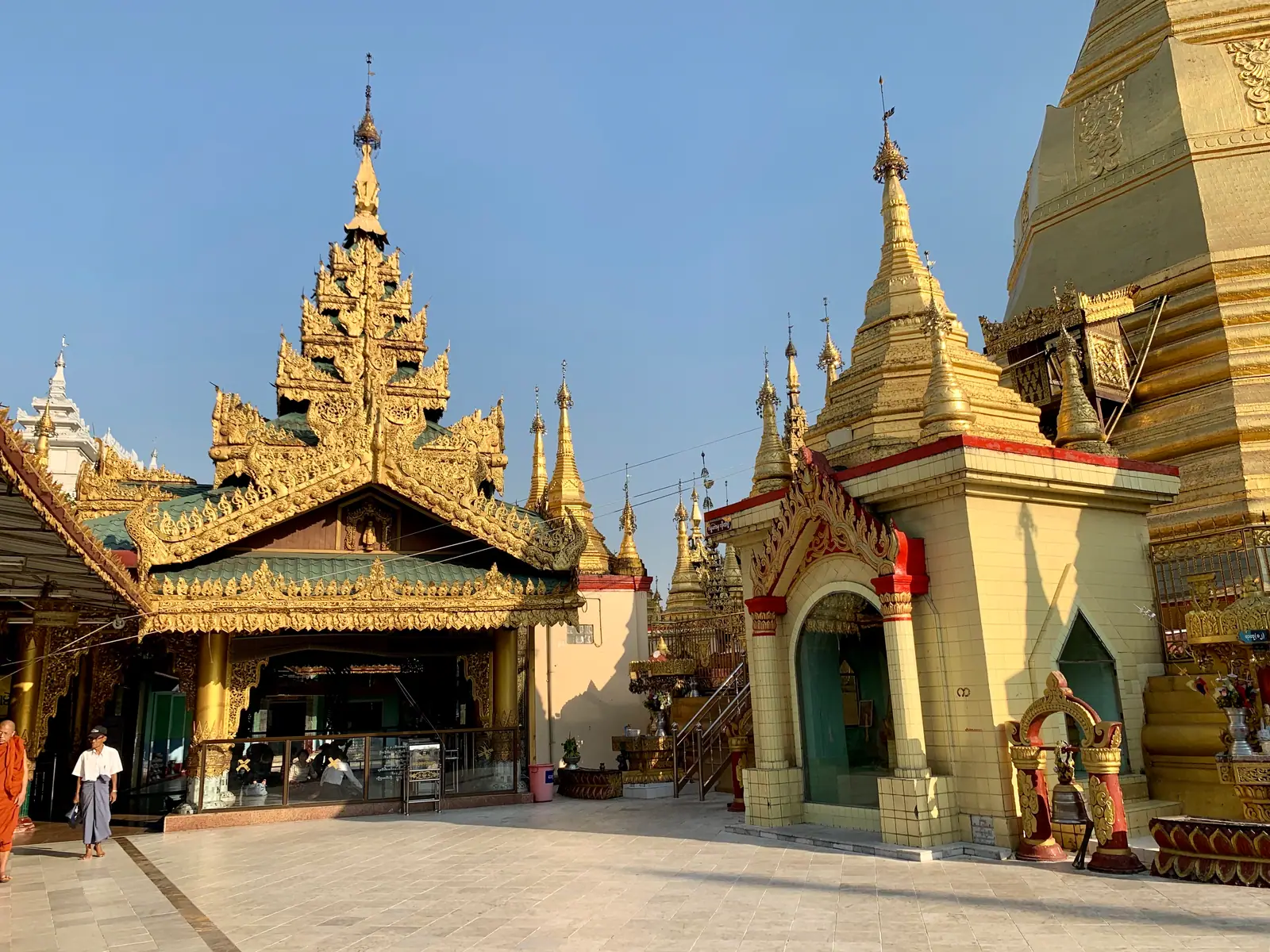
The base platform surrounds the gilded main stupa, with shrines, bells, and drums at the corners. Devotees circumambulate, offer flowers, and light candles; the bell and chanting are Sule Pagoda's most iconic soundscape.
The pagoda faces Maha Bandula Park and the Independence Monument, near Yangon City Hall and the colonial High Court, forming a 'pagoda—park—city' spatial narrative.
Sule Pagoda is in a busy downtown, surrounded by urban greenery, corner shrines, and colonial buildings. Here you see citizens exercising, devotees praying, and tourists strolling — a natural classroom for observing Yangon city life.
The pagoda sits at an open downtown junction; the octagonal gilded body stands out between City Hall and the park, with gentle platforms letting visitors approach the base without harming the heritage.
The platform is where devotees circumambulate, offer flowers, and meditate at dawn — most active then, echoing the Buddhist 'life-protecting' spirit.
Morning or evening is when the gilded body is most vivid and the crowd most relaxed. Stand on the park side looking at the spire to observe light and city rhythm.
First take in the whole pagoda from the park height, then return to the platform to see the octagonal body and praying crowd up close. Distance shows the overall form; close view reveals the city-faith relation.
This section is a science overview based on public interpretation and on-site features. For stricter historical and architectural classification, rely on official materials, on-site signs, and academic research.
About Sule Pagoda and the guardian spirit 'Sule', a local oral tradition tied to city protection is passed down: the spirit is said to guard the peace of this place, and citizens revere the pagoda and pray. Such legends may not appear in official histories, but they let the public sense how this land was imagined and cherished.
In Myanmar, Buddhism and the ancient 'Nat' (spirit) belief are not mutually exclusive, but rather ingeniously integrated. Nats were originally spirits of mountains, rivers, or deceased heroes in animism. When Buddhism arrived, these native spirits were not expelled; instead, they were 'recruited' as Buddhist guardian deities. Sule Pagoda is a perfect example: the pagoda itself is the supreme symbol of Buddhism (enshrining the Buddha's hair relic), but its name and location are credited to the ancient spirit 'Sularata'. Here, you can see devotees first pay respects to the Buddha, and then pray for worldly peace and wealth before the dedicated Nat shrines at the pagoda's base. This tacit division of labor—'the Buddha governs the afterlife, the spirit governs the present life'—forms the most authentic and vivid folk faith ecology in Myanmar.
Sule Pagoda is more than a downtown golden tower — it is an open-air classroom of city memory and faith: from the founding legend and hair relic to the octagonal gilded body and modern peaceful movements, the story of land and faith is written into the same heart of Yangon.
When you visit Sule Pagoda, what's worth reading slowly is often not the check-in board but the official signs explaining 'why this pagoda is here'.
The readings below are based on the founding history, relic legend, and structure signs set up by the Yangon City and the site, translating information visible on-site but not always read into accessible English science notes.
📍 On-site location · Platform main entrance
These signs state the key background — the meaning of Sule Pagoda as a downtown golden pagoda and its naming relation with the guardian spirit. Reading the hints is lesson one in using this urban landmark.
📍 On-site location · Base platform
The guide repeatedly emphasizes the hair relic as the faith center and reminds visitors that this pagoda is half history legend, half citizens' faith imagination. It clearly explains 'why it is a shrine'.
📍 On-site location · Platform viewpoint
The map explains 'why this is an urban nexus'. The octagonal gilded body makes Sule Pagoda unique in Yangon's skyline; seen with the colonial buildings, the pagoda's design logic becomes clear.
📍 On-site location · Park side
Erected by the city, it marks Sule Pagoda's historical role as a rallying point for the 1988 and 2007 peaceful demonstrations, echoing the 'city and faith' motif. It reminds every visitor: this junction connects the quietest faith and the loudest city memory.
Look past the surface 'pretty' to find what's truly rare about this pagoda: it is at once a city religious site, a Buddhist faith, and an open-air urban classroom.
The faith story hidden in the body
Sule Pagoda's hardest core is both visible and invisible. Visible are the octagonal gilded body and the city skyline; invisible is the hair relic of the Buddha and citizens' prayers. Visitors see the landscape; the faithful see the Buddha placed at this city center as a local text.
Sule Pagoda's cultural symbol
The octagonal gilded body, Maha Bandula Park, and colonial buildings, together with Yangon, form Sule Pagoda's identity system: reading instantly as Yangon, as Myanmar, and as a gentle, transparent urban aesthetic. From the downtown view to the dawn bell, this contrast makes it one of Yangon's most memorable images.
What's most worth learning about Sule Pagoda isn't 'it got prettier' but how it re-integrated a city junction into the public's Buddhist faith while keeping reverence for history.
Sule Pagoda isn't a 'hide the pagoda and done' case, but a model that activates city memory through religious-space design and turns it into shared place.
Signs, platform, and guide systems aren't just navigation but let every visitor, while using the space, casually respect the religious site and others.
Sule Pagoda didn't erase the faith background but, through the body and signage, lets the public sense what this land has been through while visiting.
Look past the 'pretty tower' to find what's truly rare about Sule Pagoda: it turns a city junction into an open-air urban classroom that changes with the seasons.
Cool-season colors
The cool season (Nov–Feb) is Yangon's most comfortable. Pleasant temperatures and clear air, paired with park new green, form the city's brightest pagoda-platform palette.
Hot-season colors
The hot season (Mar–May) has high sky and clear city, but hot midday; the gilded body at dawn and dusk is especially clear.
One pagoda, two tempers. Below, the scenes most worth expecting each season.
COOL
The cool season before the warm-up is the city's most comfortable, best for slow visits and dawn shots.
HOT
High sky and clear city, but hot midday; the gilded body at dawn and dusk is most photogenic.
RAINY
The rainy season (Jun–Oct) has brief showers; after rain the city is fresh and the body brighter — a different window to view the pagoda.
YEAR-ROUND
Sule Pagoda is open all year, the starting point for understanding Yangon's urban fabric; dawn and dusk are always the best windows.
Not just 'you'll like it,' but directly telling you how to walk, where to go first, and which Yangon nodes to link.
Resonance: Free, open, flat platform — kids can watch the gilded body, hear the relic story, and easily reach the park along the flat side.
Tip: Spend energy on photo stops, not on crowding; mind midday sun.
Resonance: Dawn city waking and backlit spire are Yangon's most romantic frames, with very high hit rate.
Tip: Count arrival, return, and light into the plan so composition isn't beaten by on-site pace.
Resonance: As a faith-and-history sample, the hair relic, octagonal body, and modern urban movements are worth a close look.
Tip: Avoid the most crowded weekends; choose dawn or a weekday afternoon to really observe details.
Resonance: Without going far, experience Burmese Buddhist faith and colonial urban heritage in downtown; link taxi, walking, and street food — an ideal start to the 'city and faith' theme.
Tip: If you can pick only one downtown Yangon spot, Sule Pagoda opens the 'pagoda and city' theme best.
Consolidating arrival in Yangon, in-city transfers, walking, parking, and nearby links for a clearer Sule Pagoda plan.
Sule Pagoda is at the junction of Sule Pagoda Road and Maha Bandula Road in downtown Yangon — the city's most recognizable coordinate. The easiest public transit is to fly to Yangon International Airport (RGN), then take a taxi or Grab about 30–45 minutes to downtown. Once downtown, a walk or short taxi ride from surrounding blocks takes about 5–15 minutes to the platform. The pagoda is right at the core junction; from the drop-off you walk straight onto the platform.
Around Sule Pagoda is the city core with limited parking. Plan transport, parking, and walking together — especially with seniors, young children, or luggage, parking at a nearby mall or hotel then walking greatly reduces hassle.
Flight + taxi (to Yangon)
Easiest for most travelers: fly to Yangon International Airport (RGN), then taxi or Grab into downtown — the classic route to Sule Pagoda.
Taxi / Grab (to pagoda)
Flexible and convenient; set the destination to 'Sule Pagoda' — drivers know this city coordinate, easy from any downtown hotel.
Yangon Circular Train (to Central Station)
Yangon Central Railway Station is only a few hundred meters from Sule Pagoda. Take the Circular Train then walk about 10 minutes — ideal for travelers wanting a local commute experience.
Driving (parking / mall)
Good with seniors/children, lots of luggage, or touring the city; roads near the pagoda are narrow with limited parking — park at a nearby mall or hotel.
Walk (downtown streets)
If you're already at Maha Bandula Park or downtown streets, walking is the most natural way to observe the city and pagoda.
Sule Pagoda is in the city core with no dedicated large lot. Below are the main options; rates and availability vary by time — please follow on-site signs.
| Parking option | Distance | Price |
|---|---|---|
| Nearby mall parking | about 200–500 m (to platform) | Commercial, hourly |
| Nearby hotel/office parking | about 200–600 m | Public / commercial, more spaces but tight at peak |
| Roadside temporary | about 50–200 m | Short stop only, restricted and congested |
| Yangon Central Station parking | about 500–800 m | Station parking, needs walk |
Roads near the pagoda congest on holidays and clear days; don't occupy bus or fire lanes for long. EV chargers are mostly in mall parking; rates and limits may change — check posted signs.
Sule Pagoda is reachable by day, but what truly sets the photo ceiling is the dawn city waking and the dusk light window. Arrive about 60 minutes before sunset; if weather isn't good for photos, shift focus to platform prayer or a surrounding street stroll.
The pagoda has no dedicated large lot; park at a nearby mall or hotel then walk about 5–15 minutes.
Nearby mall parking is about 200–500 m away, closest to the platform; nearby hotel parking is about 200–600 m, more spaces but tight at peak.
Little. Roads are narrow and congested; don't park roadside long — use proper parking.
Unless parking is essential, no. Downtown congests; walking or ride-hailing is smoother. If driving, park at a nearby mall then walk in.
Strongly. After flying to Yangon, take a taxi/Grab to downtown, then walk or short ride about 5–15 min to the platform. Address: Sule Pagoda Road × Maha Bandula Road, Yangon 11141, Myanmar.
For stability and ease, ride-hailing (Grab) remains optimal; once downtown, walk or short transfer. If driving is unavoidable, treat parking and transfer as part of the trip.
Practical Information
A neutral overview of the kinds of services that exist in the blocks around the pagoda. We do not recommend, rank or link to any particular business — please compare options on the spot or in a map app.
Neutrality note: we describe facility types only, never named shops or brands, and we accept no payment or commission from any operator.
Public and paid toilets are found in the surrounding commercial buildings, teahouses and shopping complexes rather than inside the shrine compound. Carry small notes for a token fee, and tissues, since supplies are often not provided.
Multi-storey and open car parks serve the downtown blocks around the pagoda; on-street space is scarce and parking is restricted on several main roads. Drivers should confirm opening hours and any motorcycle restrictions before setting out.
Within a few minutes' walk you will find Myanmar teahouses, rice-and-curry shops, noodle stalls, bakeries and international fast-food chains. Teahouses are the cheapest place to sit down; vegetarian choices are easiest at Chinese- and Indian-run restaurants.
The surrounding township concentrates hotels and guesthouses at every price band — budget guesthouses, mid-range city hotels and internationally managed properties, most of them within walking distance of the pagoda.
Convenience stores, pharmacies, mobile-phone shops and a few larger supermarkets operate in the blocks around the pagoda, generally open late into the evening. This is where to buy bottled water, SIM top-ups and basic medicine.
Petrol stations sit on the arterial roads rather than in the historical core. Public EV charging is uncommon and still developing in Yangon, so drivers of electric vehicles should plan their range in advance.
Cash in kyat remains the everyday standard around the pagoda, including at the shrine's own ticket counter. ATMs exist in the surrounding commercial blocks but are not always reliable, so keep a cash reserve.
Mobile data coverage is good across downtown Yangon and cafés generally offer Wi-Fi. Tap water is not drinkable — buy sealed bottled or purified water and refill your own bottle where you can.
Not just 'who it's for,' but a walkable half-day route you can follow directly. Centered on the downtown pagoda and colonial landmarks, linking city history and faith.
[Start] Platform & gilded spire
Settle the mind · ~30 min
Enter slowly from the Sule Pagoda Road entrance, remove shoes and pray at the base platform, look up at the octagonal gilded body, align your pace with the city, then head to the surrounding streets.
[Main] Octagonal gilded spire
Core experience · ~40 min
Circle the pagoda on the platform and look up at the octagonal gilded structure running from base to finial. Sule Pagoda's most famous landmark and the best vantage for reading 'city and faith'.
[Extend] Maha Bandula Park & Independence Monument
Local story · ~40 min
Walk to the adjacent Maha Bandula Park and read the Independence Monument to understand Myanmar's independence history, collecting city narrative and pagoda faith together.
[Refuel] Rest & light meal
Leisurely refuel · ~40 min
Hydrate at a teahouse or stall around the pagoda or in the downtown streets, then look back at the gilded spire and skyline, packing pagoda, park, and city into one walk.
[End] Yangon City Hall & colonial buildings
Wrap-up · ~60 min+
If energy allows, visit Yangon City Hall opposite the park and the surrounding colonial buildings, or extend to Bogyoke Aung San Market; otherwise return along the street, completing the 'pagoda—park—city' half-day package.
The route above emphasizes a self-contained loop you can follow as-is. If you only want the pagoda, keep the first two segments and treat the park and buildings as optional add-ons.
Route Planning
Two general routes built around how much time you have, followed by three versions tuned to how you travel. Timings assume you are walking; add 15–25 minutes whenever you cross downtown by car.
For travellers with a single slot in the city: the shrine plus its immediate civic surroundings, all on foot.
Best for: Transit layovers, first-time visitors, and anyone travelling in the hot season.
The shrine as the anchor of a downtown day, extended to a market and the city's larger monuments.
Best for: Visitors with a full day in Yangon who want context rather than a single stop.
Duration: 2–3 hours
Short, shaded and flexible, with no long stretches of walking.
Tip: A stroller is workable on the surrounding streets but awkward on the platform itself.
Duration: 2–4 hours
Light direction, silhouettes, and the contrast between the gilded spire and the colonial streetscape.
Tip: The monsoon months give the most dramatic clouds but demand protection for your gear.
Duration: 1.5–2.5 hours
Minimising steps and standing time while still reaching the shrine itself.
Tip: Travelling with a companion makes the platform far easier; allow roughly double the usual time.
Seasonal Planner
Yangon has a tropical monsoon climate. The figures below are 30-year climatological averages for the Yangon area and describe what a typical month feels like — they are not a forecast.
| Season | Months | Average high / low | Average rainfall | How to plan |
|---|---|---|---|---|
| Cool dry season | November – February | 31 °C / 18 °C | 0–30 mm per month | The most comfortable window. Expect dry, bright days and genuinely cool mornings: the best period for walking the downtown grid, photographing the shrine and combining it with the market and the park. A light layer helps at dawn. |
| Hot season | March – mid-May | 36 °C / 24 °C | 10–100 mm per month | Pre-monsoon heat builds to its annual peak, and the mid-April water festival brings the busiest days of the year. Visit before 9 a.m. or after 4 p.m., carry water, use the shaded side of the platform, and treat direct midday sun on stone as the main risk. |
| Monsoon | mid-May – October | 30 °C / 24 °C | 250–580 mm per month | The wettest months, though rain usually arrives as intense afternoon or evening showers rather than all-day drizzle. Morning slots are the safest bet; bring an umbrella, choose shoes with grip for wet stone, and allow extra time because traffic slows sharply in heavy rain. |
Heat load
Highest March–May
Direct sun on the open platform is strongest from late morning to mid-afternoon.
Humidity
70–90% year-round
High humidity makes the same temperature feel hotter and slows the evaporation of sweat.
Rain pattern
Peak June–August
Monsoon rain is convective: short, intense bursts with dry gaps in between.
Air quality
Poorest in the late dry season
Dry-season haze can reduce visibility and affect visitors with respiratory sensitivity.
Visitor density
Peak November–February and festival days
Cool-season months and full-moon festival days draw the largest crowds.
Figures are 30-year climatological normals for the Yangon area, provided as a planning reference rather than a live forecast. Always check the current outlook above before a specific visit.
Sule Pagoda is in a busy downtown and a religious site. Sorting out etiquette, safety, and budget in advance turns the experience from a 'check-in rush' into a 'relaxed visit'.
Footwear & attire
Remove shoes on platform
Remove shoes and dress modestly (cover shoulders and knees) on the pagoda platform; the platform gets scorching at noon — bring socks or mind your feet.
Busy downtown
Watch your belongings
At a central downtown junction with dense crowds and traffic, keep an eye on your belongings while photographing and praying to avoid pickpockets.
Weather & habits
Sun protection & water
Yangon is hot and humid year-round with strong sun on open platforms; visit at dawn or dusk and bring water and sun protection.
Local devotees enter free; foreign visitors buy a ticket at the entrance (a few USD), subject to on-site notice. Praying on the platform is free.
The platform is gentle and the main path is accessible; but the downtown junction is busy and the platform is hot in the sun — hold children, assist seniors, and avoid the midday heat.
Light rain is fine; the platform is slippery but you can still pray. On heavy rain or extreme heat, choose the cooler dawn or dusk hours.
This is both a visitor's downtown landmark and a religious site where devotees pray. Following these rules is double respect for history, others, and faith.
The pagoda is a place of practice and prayer. Lower your voice and don't play music aloud. Leave space for the bell, the chanting, and those who pause here.
Remove shoes and dress modestly on the platform. Don't point at sacred objects with a finger during prayer. Check whether photography is allowed and don't photograph practitioners up close.
Bins on the platform are limited. Bring a small trash bag and take everything with you when you leave — cigarette butts, plastics, and food scraps — keeping the pagoda and surroundings clean.
Sule Pagoda and the surrounding colonial buildings are public urban heritage. Don't carve or step on them, and don't throw things onto the platform, keeping this city heart safe and alive.
Understanding & Responsibility
A short, non-religious explanation of what you are looking at, and how to behave so that the site survives for the people who use it every day.
The structure is raised on an octagonal base, a form widely used in Myanmar religious architecture. Eight sides give the solid mass a symmetrical silhouette that reads the same from every approach street — which is precisely why it works as the geometric centre of a grid-plan city.
The golden surface is gold leaf applied over a prepared base and renewed periodically. Gold leaf is extraordinarily thin and degrades with handling, humidity and air pollution, which is one reason touching the structure is discouraged.
The open platform is paved in stone. Stone expands in the midday heat and becomes slippery when wet, so the surface you walk on is at once a heritage material and a practical safety factor.
The trees of the surrounding civic square form a small urban canopy in one of the most densely built parts of Yangon, moderating temperature and sheltering birds and small animals.
Footwear is removed before entering the platform. Bring socks if the stone is hot, and use the shoe racks rather than carrying shoes inside.
Circling the structure in a clockwise direction is the local custom — following it is the simplest way to move with the crowd instead of against it.
This is an active place of worship, not only a monument. Keep calls and conversations quiet and silence your phone.
Covered shoulders and knees are the basic expectation. A light scarf is useful both for covering up and for sun or dust.
Take your rubbish with you, do not smoke, and avoid leaving plastic or food offerings on the platform.
Photographs of the architecture are generally fine, but worshippers are not exhibits. Ask first, and never photograph during prayer or ceremonies without permission.
Offerings belong to the shrine itself. Decide for yourself whether to give, and give directly rather than through an intermediary.
Unmanned aircraft are not permitted in the area, and climbing on the structure is both dangerous and prohibited.
Why it matters
This is not a preserved ruin: it is a working shrine that local residents visit daily and in numbers at festival times. Visitor behaviour — far more than the weather — is what decides whether a place like this keeps the quiet that makes it worth visiting.
Yangon is a city where 'river, lake, and colonial town' coexist. We don't recommend specific hotels but help you parse two lodging patterns to choose what fits.
Closest to pagoda & city
Staying downtown puts you a short distance from Sule Pagoda, the gilded spire at dawn ideal for travelers focused on 'city stroll + pagoda' with high convenience needs.
Commute: to the platform about 5–15 min walk. Walking easy, good for dawn downtown.
Best for food & hub
Staying in the Bogyoke / City Hall area puts markets, restaurants, and cafe streets at your door — ideal for 'downtown + transfer' travelers who head to Sule Pagoda by day.
Commute: walk about 5–15 minutes. Good for self-drivers or independent travelers wanting absolute convenience.
Best for Shwedagon link
One of Yangon's commercial and passenger hubs. If your trip is not limited to Sule Pagoda and you plan to visit Shwedagon Pagoda, staying here as a transfer is most efficient.
Commute: about 15–25 minutes to Sule Pagoda. Good for transfers.
Yangon's cool season (Nov–Feb) and holidays tighten rooms and raise prices as tourists flood in. Book weeks ahead; if booking near holidays, expand the range to surrounding areas, then travel by taxi or car.
Sule Pagoda Road × Maha Bandula Road, Yangon 11141, Myanmar (Plus Code: Q5F5+WG) · Tel +95 1 371 561
After Dark & On Foot
The pagoda stays open until 23:00. After sunset the floodlights turn the gilded octagon into a glowing landmark above the traffic circle — night is when this downtown grid is at its most photogenic.
Best time
The lights come on around 18:30–19:00, just after sunset. Arrive in the blue hour for the strongest contrast between the gold spire and a deep blue sky.
Where to stand
The south-east corner of the platform looks down Sule Pagoda Road; the Maha Bandula Park side frames the spire together with City Hall.
Shooting tips
The gilded surface is extremely bright at night. Hold the highlights, brace against a railing or bring a small tripod — long exposure turns passing traffic into light trails.
💡 After dark the platform is cooler and much quieter, but keep a respectful distance from worshippers and never use flash during prayer. The junction itself is busy — watch your belongings.
The pagoda sits in a walkable downtown grid, so several stops can be strung together on foot without taking a taxi.
Pavements around the junction are uneven and often blocked by vendors. Cross at the signalised crossings, and take a taxi after dark.
Practical information about Sule Pagoda's facilities, history, and visit planning.
The pagoda has no dedicated large lot; park at a nearby mall or hotel then walk about 5–15 minutes.
Sule Pagoda has a flat platform; wheelchairs and strollers can reach most areas via the main path. But the downtown junction is busy — stay on the platform with company.
As an open religious site, restrooms and snacks concentrate at the entrance shops and nearby; resupply water and food there before entering the platform.
The pagoda is in the downtown commercial core; banks, exchange counters, and ATMs are dense — visitors can get cash on the way in.
'Sule' derives from the guardian spirit (Nat) in Burmese folk belief. Named after the spirit, the pagoda has stood at the city's center since its founding — Yangon's spiritual coordinate.
Sule Pagoda is not a man-made theme park but turns a city junction into a public space uniting Buddhist faith, an octagonal gilded body, a hair relic, and city memory. It is both a religious site and a witness to modern Burmese history.
Local devotees enter free; foreign visitors buy a ticket at the entrance (a few USD), platform prayer is free — visit anytime (please respect the religious site and avoid late-night noise).
A relaxed walk takes about 1–2 hours (including platform and photo stops); allow half a day if you also visit Maha Bandula Park, Yangon City Hall, and Bogyoke Market.
Yes — the platform is open space, visitable in any weather. But the platform is hot in the sun and slippery in rain; take sun and slip precautions, wear comfortable shoes, and watch the weather.
From Sule Pagoda you can link Maha Bandula Park, Yangon City Hall, the Independence Monument, and Bogyoke Aung San Market, even extending to Shwedagon Pagoda 3 km away, into a half-day 'pagoda—park—city' cultural route.
Dedicated pages on tickets, opening hours, history, directions, photography and nearby sights — so you can plan every part of your visit.
Sule Pagoda Entrance Fee & Tickets
Foreign visitors pay an entrance fee at Sule Pagoda in Yangon; local devotees enter free. Learn where to buy tickets, what is included, payment tips and current pricing.
Sule Pagoda Opening Hours
Sule Pagoda is open daily from early morning to late night in downtown Yangon. Plan around the 04:00–23:00 hours, ticket-booth times and the best light for photos.
History of Sule Pagoda
Sule Pagoda in Yangon is believed to be over 2,000 years old, enshrining a hair relic of the Buddha, and became a focal point of Myanmar’s modern democratic movements.
How to Get to Sule Pagoda
Sule Pagoda sits at the junction of Sule Pagoda Road and Maha Bandula Road in downtown Yangon. Find directions from the airport, railway station and city centre.
Photographing Sule Pagoda
Capture Sule Pagoda’s gilded spire at golden hour and blue hour, and the lit stupa at night. Tips on the best spots, respectful dress and the colonial backdrop.
Things to Do Near Sule Pagoda
Around Sule Pagoda in downtown Yangon you’ll find Maha Bandula Park, Yangon City Hall, the Independence Monument, Bogyoke Aung San Market and more.
As Yangon's most recognizable city pagoda, a few structured spots and times greatly improve your photos' usefulness and beauty.
📍 Park viewpoint
From dawn to dusk, the city greenery and gilded spire below are the classic 'park—pagoda' composition; the body silhouettes beautifully backlit.
📍 Street corner
From the street side, frame 'traffic + gilded spire + colonial buildings' together — Sule Pagoda's most recognizable spot.
📍 Base platform
The devotees circumambulating and the gilded body's colors are the pagoda's most atmospheric window; paired with morning light, the body sparks the imagination.
📍 Pagoda toward the junction
After dark, the body lights up, the gilded surface reflects a river of lights — ideal for closing long-exposure night shots and urban portraits.
From the gilded spire and octagonal body to Maha Bandula Park and the colonial buildings — see the visual beauty of Sule Pagoda.
Image rights: all images displayed on this website remain the property and copyright of their respective photographers.
Visitor Quotes
“Looking up from the downtown junction, the gilded spire is right above the traffic — that quiet in the bustle is special, and at dusk the light makes it feel like floating above the city.”
“A free and open city pagoda, steps from Maha Bandula Park — the most underrated corner of downtown Yangon.”
“Walking the platform with my child, he watched the gilded body and heard the relic story; even my parents walked easily.”
Visitor feedback is available on Google Maps (external link).
Source: Google Maps visitor rating and review count, accessed October 2026. Ratings change over time — see Google Maps for the latest. Google Maps ↗
Visited at dawn; the backlit gilded spire is so photogenic, and the moment on the platform was completely silent — strongly recommend sunrise, best light.
The octagonal body is healing; about 10 min from Central Station, strong city vibe, mind the sun.
Worth it as a city landmark; weekends are crowded — weekdays or mornings are more comfortable.
About 10 min walk from Central Station to the platform; the city and corner shrines along the way are pleasant for a half-day stroll.
Every fact on this page is cross-checked against the public sources listed below. This is an independent, non-profit visitor guide and is not affiliated with any official body.
Rating and review count are taken from Google Maps at the time of the latest update (October 2026) and may change.
Rating 4.4, 6,618 reviews, address, telephone and opening information
Official tourism portal of Myanmar
Official regional government portal
History, legend and architectural background
Live weather and sunset data used by the light planner on this page
For official updates and regional tourism information, visit the Myanmar / Yangon Region official tourism portal. Myanmar / Yangon Region Official Tourism Portal
Image rights: all images displayed on this website remain the property and copyright of their respective photographers.